Thursday, November 10, 2016

Religious Freedom

Erin McNulty 11/9/2016

Religious freedom has become a hot button topic in politics in recent years, particularly in instances like the Little Sisters of the Poor Supreme Court case, Indiana's Religious Freedom Restoration Act and the backlash that ensued from it, and bathroom policies at Target stores nationwide. The latter two "religious freedom issues" mentioned have been talked about ad nauseam in the media and in Facebook posts, but it is easy to forget in the controversy that America was founded on the very concept of religious freedom. From the Puritans of Massachusetts to the Catholics of Maryland, many of the original thirteen colonies were formed by religious groups fleeing persecution in their home countries and seeking a new start in a new land. To this day, immigrants still come to America in order to practice their religion freely, a right that is protected by the First Amendment to the US Constitution. 

The Catholic Church also advocates for religious freedom in Vatican II document Gaudium et Spes. The council argues that "the right to express one's own opinion and to profess one's religion both publicly and privately" (73) is one that should be protected by governments. The council urges respect not only for the Christian religion, but for other religious opinions as well, and denounces governments and political systems that oppress religion and "hamper civic or religious freedom, victimize large numbers through avarice and political crimes, and divert the exercise of authority from the service of the common good to the interests of one or another faction or of the rulers themselves" (73). In the opinion of the council fathers who wrote Gauidum et Spes and the Catholic Church as a whole, religious freedom should come from a place of tolerance and compassion and from respect for the common good. "There is no better way to establish political life," the council explains, "on a truly human basis than by fostering an inward sense of justice and kindliness, and of service to the common good" (73).

Recently in America, there has been what seems to be a trend away from the idea of "freedom of religion" to "freedom from religion." Meaning, instead of primarily protecting the right to express and practice religion, American politics has become more focused on protecting the right to not have religion forced upon anyone. This has begun to spiral to a point where many simple expressions of religion are considered attacks on those who do not follow the particular religion being expressed. A perfect example will be thrown back into the public eye as the holiday season approaches. The greeting "Merry Christmas" is considered by some non-Christians to be offensive, and this debate has manifested itself in many forms over the past few years in many different ways, like last year's Starbucks cup debate. I believe that our country could benefits from Gaudium et Spes' approach and view individual expressions of religion with tolerance, respect, and love, rather than as an attack, especially in this holiday season after a particularly divisive election.




Do Elections Encourage a Godless America?

The 2016 presidential election is surely an event to be etched in history.  The entire ordeal felt more like a reality television show, than a battle of intellect to win the title of leader of the free world.  This was the very first election where I was able to cast a vote.  This should have been an exciting time for me.  I should have been able to go home from the polling site with a feeling in my stomach like I made a difference.  Instead, I felt sick to my stomach with the options laid out before me.  On the one side I could choose Donald Trump, referred by many as a sexist, racist, hate-inciting billionaire; while in the other corner I could choose Hillary Clinton, a lying, stealing, corrupt socialist.  These odds almost made me not want to vote at all, maybe if I didn't vote then I wouldn't feel upset over the outcome.  What about this election could possibly make me excited about exercising my right to vote?


Nevertheless, I put my attitude aside and decided to vote, and when the victor was announced I went to sleep accepting the result just like the previous elections I have lived through.  Waking up the next morning, I saw how much anger so many Americans harbored over the results.  It made me wonder, where was God during this election season?  Would God want us to be angry and hateful to each other like we have been exhibiting over the past year and a half?  While many people blame Trump for inciting this rage in the American people, I think the rage already existed.  He simply knew how to foster that rage and let it grow to win the election.


Gaudium et spes details many different aspects of politics and religious life.  In Chapter 75, it says, "Citizens must cultivate a generous and loyal spirit of patriotism, but without being narrow-minded.  This means that they will always direct their attention to the good of the whole human family, united by different ties which bind together races, people and nations."  This election does not reflect the sentiments laid out in GS.  Some citizens' misguided view of patriotism has led them to sentiments of hate, while others have let the outcome of the election drive them away from unity and looking out for the good of the "whole human family."

God teaches us to treat everyone with respect and to always look to our moral and religious compass when making important decisions.  I think that this election proves that many of us have lost our moral compass and perhaps need the help of God to get it back.


JFK: America's First Catholic President


One of the most fundamental principles of democracy is the separation of church and state.  The United States of America was founded due to the fact that colonists faced religious oppression and needed to escape to freedom.  In the 1960 presidential election, the question of church and state was roused when John F. Kennedy was the democratic hopeful.  In this video, JFK gives a historical and monumental speech to defend himself to a room of protestants that his religious beliefs would not cloud his judgement as the president.

3:30 - JFK makes calls for an America "where all men and all churches are treated as equals."  This sentiment illustrates a doctrine that is not only democratic, but religious as well: the idea that we are all equal and deserve to be treated as such.  While this may seem to be the creation of a secular society, I think that this call for equality can be credited with the Catholic church as well.  In Gaudium et spes, it states, "It is clear, therefore, that the political community and public authority are founded on human nature and hence belong to the order designed by God, even though the choice of a political regime and the appointment of the rulers are left to the free will of citizens" (GS 74).  This statement recognizes the fact that, while it is up to people of different backgrounds and religious affiliations to choose leaders, God still plays a part and hopes for the fair and equal treatment of all.

9:30 - Here Kennedy tells the crowd that if he were asked to violate his conscience or the national interest, he would have to step down from his position.  This statement shows that while he assures the crowd that religion will not govern his actions, he will not tolerate being asked to give up what he believes in order to run this country.  That is the beauty of America: we can choose our own religion and still hold the ability to make political decisions without persecution.

This election was only a few years before the release of the Second Vatican Council.  I think that it reflects the sentiments of the Catholic Church in changing for the times.  It also sets an important precedent for future Catholic public figures in America in the eyes of voters.


Wednesday, November 9, 2016

Voting: A Moral and Civic Obligation?

Erin McNulty 11/9/2016

"Did you vote today?" I, like most of us, heard this question countless times yesterday on November 8th, the day of the 2016 General Election. I actually didn't vote yesterday, but instead sent my absentee ballot back to my home (swing) state of Ohio by mail last week. This is the first election that I have been able to participate in and the whole process was actually pretty overwhelming. There is much to consider when filling out one's ballot; not just who to vote for as President of the United States, but which state representatives, county judges, and amendments to my village charter I want to support.


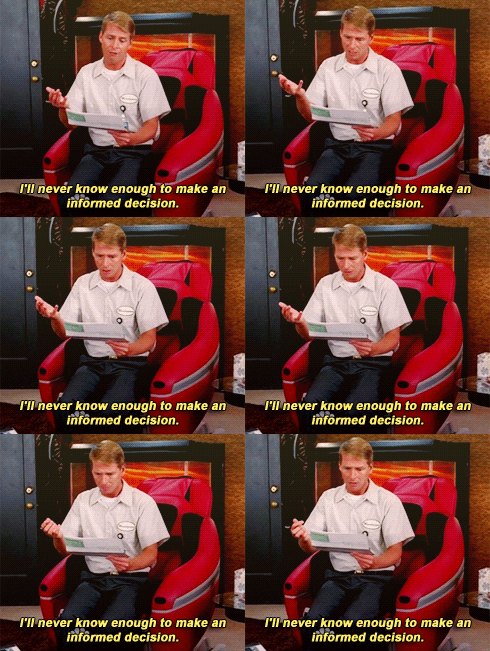
Despite feeling a little bit like 30 Rock's Kenneth in the above gif when first looking over my ballot, I voted according to the issues I support, using my values and my conscience as my guide. While this election cycle did not feature the ideal candidates in the opinion of many Americans, including myself, I still did feel proud to vote in my first election. I am truly grateful to live in a country where I can participate in my government in such a direct way. 


Patriotism and civic duty plays a large role in encouraging myself and other Americans to vote, but what about morality and religion? Do these convictions encourage people to vote? Gaudium et Spes makes it very clear that the Catholic Church enthusiastically encourages its members to take part in politics in the capacity their country allows. "All citizens," the council states, "should be mindful of the right and also the duty to use their free vote to further the common good" (75). Here is where the Church's push for political participation takes things one step further: the Church urges political participation not simply out of duty for one's country, but also, more importantly, out for duty for all of humanity. "Citizens must cultivate a generous and loyal spirit of patriotism, but without being narrow-minded" (75), argues the council.  "This means that they will always direct their attention to the good of the whole human family, united by the different ties which bind together races, people and nations" (75). In this way, for the Church, one must vote according to their conscience and their morals in order to decide what will be best for their whole nation, not for their own self-interest. 

So, participate in politics to to fulfill your duty as a citizen, but more importantly, vote to fulfill your duty to support and advance the common good. "All Christians," the council explains, have "their own specific vocation within the political community...It is for them to give an example by their sense of responsibility and their service of the common good" (75). More reason than any to let your voice be heard!


Post Election Blog: Should Catholics Be Involved in Politics?

Congratulations! You just lived through a historical time for the United States... the 2016 Presidential Election.  At this point, it seems many people are tired of talking about the election as it brings negativity and divide.  As a Politics major, I can talk about this election for days, but this is not going to be about the election.  This is going to be about the more bright side of Politics and the Church's view of the political realm.  Just as the United States has a list of principles all composed into what we call The Constitution, the Catholic Church has a document similar to a constitution entitled Gaudium et Spes.  This document addresses a wide range of topics and asserts the church's view on these topics.  From the family life to culture, and even politics this document is a source of the foundational beliefs of the Church. 

Admittedly, American politics can be boring, expensive, and even sometimes dirty, but politics is crucial to a nation's success.  The church does not condone politics, but rather it embraces the rights it gives to people.  "The protection of the rights of a person is indeed a necessary condition so that citizens, individually or collectively, can take part in the life and government of a state" (GS 73).  The fundamental aspect of this freedom allows us to make choices not only individually but collectively.  The choices we make as Christians can be reflected in the political sphere because of this virtue of freedom.   

Many people may feel confused, hopeless, or even "doomed" after seeing the results of the election last night.  But one thing to keep in mind is that the church would want people to be the best person and Christian they can be.  This does not mean go around to the political parties, supporters, or protestors and push religion into their faces.  This means representing yourself as a good Christian through your actions and words.  It is through times of tension and divide that we are tested not just as individuals but as Christians.  Although we live in a country where church and state are separated, Christians (of all ages) have a "responsibility" of "service to the common good" and they can achieve this through their participation in a political community (GS 75). 

  It is ok to be concerned with the current political events and aftermaths of the election that are occurring in the U.S. today, but hopefully it will bring a peace to mind that although the church will always be a step above the political system here on earth since "her role and competence, is not bound to any political system" (GS 75).  As the sign says above, "No matter who is president, Jesus is King."

Last but not least, here is a video from a popular youtuber about Politics and Christianity.  He brings up important points about our roles as Christians and how we should act in Politics.  One major take away is a quote which refers to Jesus as "the lamb" and he states, "we are worshipers of the lamb, not of the elephant or donkey."

CatholicVote Imagine the Potential Video (January 2009)


Erin McNulty 11/9/2016

This video is an ad commissioned by the organization, CatholicVote. The ad is very interesting for many reasons. Firstly, it is a political ad sponsored and created by a faith-based organization. This is a perfect example of  the fact that despite the formal separation of Church and State in America, religion and morals often play a large role in the political opinions of American citizens. This ad by CatholicVote does not, however, advocate for a specific politician or political party, but instead campaigns for an issue that the Catholic Church has fought for throughout the modern era, particularly since the Supreme Court ruling on Roe v. Wade: the right to life. In its section on politics, Gaudium et Spes states that "the rights of all persons...must be recognized, respected, and furthered." The Catholic Church argues that life begins at conception and therefore, the unborn are entitled the same rights as those who have been born, most especially the right to life. This ad promotes the pro-life cause in a different light than most by pulling in politics rather than going against them by showing that every unborn life has immense potential, even the potential to become the first African-American president.


President Obama's Speech at the National Prayer Breakfast ( February 2016)

11/9/2016

Ashley Santamarina

This video clip is from the 2016 National Prayer Breakfast.  The whole speech is included in the video, but I will point out a few key statements.

2:00 - President Obama references Second Timothy; "For God has not given us a spirit of fear, but of power and of love and of a sound mind."  I think this is a good verse for a President to bring up because the President is a man with the most powerful position in the nation.  He needs to lead the nation with power, love, a sound mind, and most importantly, with God.  The President makes difficult decisions on a daily basis, and he cannot do it alone.

6:40 - Here, President Obama says, "What better time than these changing, tumultuous times to have Jesus standing beside us, steadying our minds, cleansing our hearts, pointing us towards what matters."  This quote again reflects the power of having a steady mind of God and making decisions with a pure heart.  This quote specifically reminded of Silence by Shusaku Endo in the way that Obama and Endo both remind us that Jesus is always beside us, even if we think he is being silent.  This line also reminded me of Gaudium et spes because the President mentions that we need to focus on what matters in these 'tumultuous times,' just like the Council Fathers remind us to scrutinize the signs of the times with a Catholic mind.